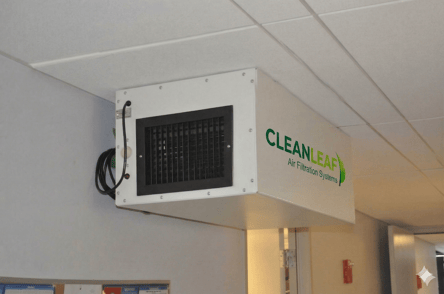
ISO 14001 Dust Control: How CleanLeaf and Blue Ox Air Cleaners Support Your Environmental Management System
Summary
ISO 14001 certifies your environmental management system (EMS), not individual products. CleanLeaf air filtration systems can serve as operational controls within your EMS and help you build the monitoring records auditors look for, making fugitive dust easier to control, measure, and document.
QUICK SUMMARY
- ISO 14001 certification is issued by an independent third-party auditor to your EMS, not to equipment.
- Fugitive dust can be identified as an environmental aspect and, where it is determined to be significant, tied to a measurable reduction objective.
- CleanLeaf units support Planning, Operation, Performance Evaluation, and Improvement (Clauses 6, 8, 9, and 10).
- Audit-ready records include PM readings, a unit floor plan, SOPs, maintenance logs, and filter disposal records.
- Facilities with combustible or metal dust should align with NFPA 660, effective December 6, 2024.
Table of Contents
What Does ISO 14001 Actually Certify?
If your facility is pursuing or maintaining ISO 14001 certification, you've probably heard some version of this question: "Will this equipment make us ISO 14001 compliant?" It's a fair question, but it rests on a common misunderstanding about how the standard works.
ISO 14001 certifies your environmental management system, not individual products. No air cleaner, dust collector, or filter can be "ISO 14001 certified" on its own. Certification is issued by an independent, accredited third-party auditor who evaluates your entire system: how you identify environmental impacts, how you control them, how you measure results, and how you improve over time.
That's where CleanLeaf comes in. For facilities dealing with airborne dust and fine particulate, especially in manufacturing and production environments, CleanLeaf units can be a practical, documentable part of your environmental program.
Where CleanLeaf Fits in Your ISO 14001 EMS
ISO 14001 follows a Plan-Do-Check-Act structure. Here's how ambient air cleaning maps to four of the standard's key clauses.
Planning (Clause 6): Identify Dust and Determine Whether It's Significant
During planning, your organization identifies its environmental aspects, meaning the activities that interact with the environment, and then applies its own criteria to determine which of those aspects are significant. If your processes generate airborne particulate, fugitive dust is a natural aspect to identify.
Objectives are set for the aspects you determine to be significant, so identifying fugitive dust does not by itself require an objective. In many dust-generating operations, though, factors such as emission volume, worker exposure, neighboring properties, and permit conditions lead facilities to rate it as significant. When that's the case, here's what the next steps typically look like:
- Set a measurable objective, such as reducing PM2.5 concentrations against a documented baseline in a specific area
- Use an OX1100 for focused dust capture in smaller workrooms
- Use an OX3000 for larger dust and particulate loads
- Consider the OX3500C or OX4000 for larger production and industrial facilities
Even where dust isn't rated significant, ambient air cleaning can still serve as an operational control and a source of monitoring data for your EMS.
Operation (Clause 8): Put a Standard Operating Procedure in Place
ISO 14001 expects operational controls to be defined and consistently followed. For air cleaners, that means a simple written SOP that covers:
- Placement: where each unit is installed and how air is intended to flow through the space
- Start/stop: when units run, such as during production shifts or specific dust-generating tasks
- Filter maintenance: inspection frequency and clear change-out triggers, such as differential pressure readings or run hours
Keeping replacement filters on hand makes it easier to follow your change-out schedule without gaps that could show up during an audit.
Performance Evaluation (Clause 9): Monitor and Review the Data
Auditors want evidence that your controls are working. Track:
- PM2.5 and PM10 readings in the areas your units serve
- Filter condition, using differential pressure or operating hours
Review these trends at regular intervals, such as during management review, and compare them against your baseline and objective.
Improvement (Clause 10): Use the Data to Refine Your Approach
ISO 14001 is built around continual improvement. Use your monitoring data to adjust unit placement, airflow patterns, operating schedules, and filter strategy over time. Document what you changed and why. That record of adjustments is itself evidence of a functioning EMS.
Audit-Ready Records to Keep
When your auditor asks how you're controlling fugitive dust, these records make the answer easy:
- Baseline and post-installation particulate readings (PM2.5/PM10)
- A simple floor plan showing unit locations and intended airflow
- Your SOP for operating and maintaining the units
- Maintenance and filter-change logs with dates and readings
- Used-filter handling and disposal records
Combustible Dust Safety: What NFPA 660 Means for Your Facility
Environmental management and fire safety are separate responsibilities, but they often overlap in dusty facilities. If your process involves combustible or metal dusts, make sure your controls and documentation align with the current combustible dust standard.
NFPA 660: The Standard for Combustible Dusts and Particulate Solids took effect on December 6, 2024. It consolidates six previously separate standards into a single document: NFPA 652, NFPA 61, NFPA 484, NFPA 654, NFPA 655, and NFPA 664.
Legacy references: Many facilities still reference the older standard numbers, and some jurisdictions and insurers may still cite a legacy edition until they update their adoption.
Confirm the applicable requirements with your authority having jurisdiction (AHJ), and have a qualified professional evaluate combustible dust hazards, including your Dust Hazard Analysis, before selecting or placing any equipment.
Reference: NFPA 660: Standard for Combustible Dusts and Particulate Solids
Building Dust Control Into Your EMS
Whether you're setting a new dust-reduction objective or strengthening the controls you already have, the right air cleaner, sized and placed correctly, makes it easier to hit your targets and prove it at audit time.
Request a quote and a CleanLeaf product expert will help you find the right air filtration system for your space.
FAQs: ISO 14001 Dust Control
Does CleanLeaf satisfy ISO 14001?
ISO 14001 certification is issued by third-party auditors to your EMS. Equipment like CleanLeaf provides the documented controls and performance evidence those auditors look for.
Can equipment be ISO 14001 certified?
No. ISO 14001 applies to an organization's environmental management system, not to products. Equipment can support your EMS as an operational control and a source of monitoring data, but the certification belongs to your organization.
How do I add fugitive dust to my ISO 14001 EMS?
Identify fugitive dust as an environmental aspect during planning, then apply your significance criteria to determine how it should be managed.
Aspects you determine to be significant are the ones that drive objectives, so if dust is rated significant, set a measurable reduction objective against a documented baseline and define the operational controls, such as ambient air cleaners, you'll use to meet it. Then monitor PM readings and review the results as part of management review.
What records should I keep for air cleaners in my EMS?
Keep baseline and post-install PM readings, a floor plan with unit locations and airflow, your SOP, maintenance and filter-change logs, and used-filter disposal records.
What replaced NFPA 652 and NFPA 654?
NFPA 660, effective December 6, 2024, consolidated NFPA 652, NFPA 654, and four other combustible dust standards (NFPA 61, 484, 655, and 664) into one document. Check with your AHJ to confirm which edition applies to your facility.
You may also like:
- Silica Dust Control
- CleanLeaf Filter Replacement Schedule
- How Many Air Filtration Systems Do I Need?