How Many Air Filtration Systems Do I Need for My Indoor Cultivation Facility?
Summary
Proper air filtration is one of the most critical investments in any commercial indoor cultivation facility, but getting the right number of units matters just as much as choosing the right technology. Too few units and you're left with stale air pockets and unaddressed contamination. Too many and you've overspent without proportional benefit. This guide walks through exactly how to calculate your CFM requirements, choose the right filtration series, and determine the ideal number of units for your space.
Table of Contents
Why Air Filtration Unit Count Matters
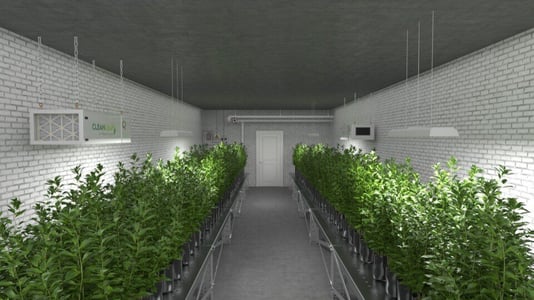
Air filtration systems in commercial facilities are designed to work in tandem, not in isolation. When strategically placed, multiple units create a pattern of circular airflow that ensures every cubic foot of your space is actively cleaned on a regular cycle. This coordinated approach helps facilities:
- Eliminate stale pockets of air where contaminants can accumulate
- Control VOCs and odors before they affect product quality
- Prevent insects, pests, and airborne bacteria from settling on plants
- Ward off mold and fungal threats that thrive in humid, stagnant air
The number of units required to achieve this depends on one key variable: CFM, or cubic feet per minute, the rate at which your filtration systems collectively move and clean the air in your space.
Choosing the Right CleanLeaf System for Your Application
CleanLeaf and Blue Ox air filtration systems are organized by the type of contaminant you need to control. Every unit is available in multiple sizes and configurations to accommodate small dedicated rooms all the way up to large commercial facilities.
Bacteria, Mold & Mildew For facilities where biological contaminants are the primary threat, medical-grade HEPA and combined carbon+HEPA units capture mold spores, pollen, powdery mildew, and fine bioaerosols before they can settle on plants or surfaces. Options range from compact units for clone labs and mother rooms to high-volume systems for large flower and vegetation rooms.
Featured units:
Blue Ox OX1100-HE, OX2500-HE, OX2500D-HE
CleanLeaf CL1250D-HE, CL1250D-CCPHE, CL2500D-CCPHE
Dust & Particulate Airborne dust, pollen, and fine particulate reduce visibility, degrade equipment, and compromise plant health. This category covers a wide range of capacities — from focused dust capture at trim tables and small workrooms up to ultra high-capacity industrial systems designed for large-scale production environments with heavy ongoing airborne debris.
Featured units:
Blue Ox OX1100, OX2500, OX2500D, OX3000, OX3500C, OX4000, OX4500, OX7000
Light Odor For facilities managing everyday plant and terpene odors, high-mass activated carbon configurations and hybrid carbon+filter systems temper smells during work shifts without sacrificing particulate control. These units work well in production zones, packaging areas, and staging rooms where odors tend to concentrate.
Featured units:
Blue Ox OX1100-CF, OX2500-CF, OX2500D-CF, OX3000-CF, OX3500C-CF
CleanLeaf CL1250D-CF, CL1250D-CCPHE, CL2500D-CCPHE
Heavy Odor For facilities with challenging or strictly regulated odor loads, dual carbon banks and multi-stage systems deliver deep adsorption and longer service life. These units are well suited for flowering rooms, trim and cure spaces, and any environment where odor migration toward offices, lobbies, or neighboring areas is a concern.
Featured units:
Blue Ox OX1100-CC, OX2500D-CC
CleanLeaf CL1100-CFP, CL1250D-CCP, CL2500-CFP, CL2500D-CCP
Smoke Designed to reduce visible haze and fine particulate generated during trimming, processing, and similar operations, smoke units combine carbon and multi-stage filtration to capture fine particles and nuisance odors simultaneously. Available in configurations from small prep spaces to large industrial environments.
Featured units:
Blue Ox OX1100-CF, OX2500D-CF, OX3000-CF, OX3500C-CF
CleanLeaf CL1250D-CF
Portable For spaces that need quick setup, temporary coverage, or frequent reconfiguration, portable units roll between rooms as needs change. Ideal for temporary trim rooms, pop-up processing areas, or any space where fixed ducting isn't practical.
Featured units:
Not sure which system fits your situation? Our team can match you to the right unit based on your contaminant type, room volume, and facility layout.
How to Calculate Your CFM Requirements
Sizing your air filtration system correctly starts with understanding the volume of your space and how many times per hour that air needs to be fully exchanged.
Step 1: Calculate the volume of your facility space
Multiply the length, width, and ceiling height of your room:
L × W × H = Total Room Volume (cubic feet)
Step 2: Apply the air exchange rate
CleanLeaf units are designed to exchange the air in a facility 8 times per hour — a standard that ensures consistent, thorough filtration throughout the space.
CFM = (Room Volume × Air Changes per Hour) ÷ 60
Example Calculation:
- Room dimensions: 30 ft × 20 ft × 20 ft = 12,000 cubic feet
- 12,000 × 8 air changes per hour = 96,000
- 96,000 ÷ 60 minutes = 1,600 CFM required
Step 3: Match your CFM to available units
CleanLeaf units across all series range from 400 to 2,100 CFM. For the example above, multiple unit configurations could satisfy the 1,600 CFM requirement — including a single high-capacity unit or a combination of mid-range units placed for optimal airflow coverage.
Getting a Facility-Specific Recommendation
Every facility is different. Ceiling heights, room configurations, humidity levels, plant density, and contamination risk profiles all factor into the optimal filtration layout.
While the CFM calculation above gives you a strong starting point, our team can provide a precise recommendation tailored to your space, including which series is the best fit and how many units to deploy for maximum effectiveness.
FAQs: Commercial Air Filtration Systems
What is CFM and why does it matter for air filtration?
CFM stands for cubic feet per minute, it measures the volume of air a filtration unit moves in a given time. Matching the total CFM of your units to the volume of your space ensures that all the air in your facility is being actively filtered at the appropriate rate, leaving no stale or contaminated pockets behind.
How many times per hour should the air in my facility be exchanged?
CleanLeaf systems are designed to exchange facility air 8-10 times per hour. The appropriate exchange rate for your specific facility may vary depending on factors like humidity, plant load, and contamination risk, our team can advise on the right target for your application.
Can I use just one large unit instead of multiple smaller ones?
In some cases, yes — but placement matters as much as capacity. Multiple units distributed strategically throughout a space typically produce more consistent airflow and eliminate dead zones more effectively than a single unit, even a high-capacity one. A facility layout review can help determine the best configuration.
Do I need professional help sizing my air filtration system?
The CFM formula in this guide gives you a reliable estimate, but professional guidance is strongly recommended for larger or more complex facilities. Factors like irregular room geometry, high humidity environments, multi-room layouts, and specific contamination concerns can all affect the optimal unit count and placement strategy.
What happens if I install too few filtration units?
Undersized filtration leads to insufficient air exchanges, which allows airborne contaminants — mold spores, bacteria, pollen, dust, and pests — to accumulate and settle. This increases the risk of crop loss, product quality issues, and failed compliance inspections. Getting the unit count right from the start is significantly less costly than addressing a contamination event after the fact.
Which CleanLeaf system is best for mold and spore control?
Units in the Bacteria, Mold & Mildew category — including the Blue Ox OX-HE and CleanLeaf CCPHE and HE models — use medical-grade HEPA filtration to capture spores, pollen, and fine contaminants. For facilities that also need odor control alongside mold protection, the CCPHE hybrid units combine HEPA-grade filtration with activated carbon in a single system.
What system should I choose if odor is my primary concern?
That depends on the intensity of the odor load. For everyday plant and terpene odors, the Light Odor category — including CF-series units from both Blue Ox and CleanLeaf — provides effective carbon-based control. For more demanding or regulated environments, the Heavy Odor category features dual carbon banks and multi-stage systems engineered for deep adsorption and longer service intervals.
Do you have systems for large industrial or commercial spaces?
Yes. The Blue Ox line includes several high-capacity units — including the OX4000, OX4500, and OX7000 — specifically designed for large-format commercial and industrial environments with heavy ongoing particulate loads and high airflow requirements.
You may also like: