Silica Dust Control: Why Choose CleanLeaf to Protect Your Workers?
Summary
For workers in stone countertop fabrication, masonry, construction, and other silica-exposed trades, airborne crystalline silica is a hidden hazard with life-altering consequences. CleanLeaf air filtration systems are purpose-built to tackle this challenge head-on, delivering measurable improvements in air quality and helping employers meet or exceed OSHA standards.
QUICK SUMMARY
- Crystalline silica is released during cutting, grinding, drilling, and polishing of stone and masonry products.
- Inhaling silica dust causes silicosis, lung cancer, COPD, and kidney disease—all preventable.
- OSHA's PEL for crystalline silica is 100 μg/m³; NIOSH recommends a stricter 50 μg/m³.
- CleanLeaf air filtration units remove up to 95% of airborne particulates and exchange room air 8x per hour.
- A multi-layered approach, engineering controls + CleanLeaf filtration + PPE, delivers the strongest protection.
Table of Contents
Who Is at Risk of Silica Dust Exposure?
Crystalline silica occurs naturally in rocks, sand, and minerals including granite, sandstone, and quartzite. While finished stone products are safe to handle, the moment they are cut, ground, drilled, or polished, they release microscopic silica particles into the air, directly into workers' breathing zones.
Industries with significant silica exposure risk include:
Stone Countertop Manufacturing, Finishing & Installation
- Cutting, grinding, edging, and contouring natural and engineered stone
- Dry polishing and high-speed power tool operation
- Moving and mixing bulk raw materials or opening bags of ground quartz
- Cleaning dust collector baghouses, scrapers, and mixers
Masonry & Tile Work
- Cutting, grinding, and finishing concrete, brick, mortar, and ceramic tile
- Mixing and handling dry mortar, grout, and cementitious materials
Foundries & Metalworking
- Sand casting and molding processes
- Abrasive blasting and finishing of metal parts
- Handling and processing silica-containing refractory materials
Glass Manufacturing
- Crushing, mixing, and handling raw silica-containing materials
- Cutting, grinding, and polishing finished glass products
Ceramics & Pottery Production
- Mixing, sieving, and handling dry clay and glaze powders
- Trimming, sanding, and finishing ceramic products
Construction & Demolition
- Cutting, grinding, and drilling concrete, masonry, and drywall
- Sweeping and cleanup of silica-containing debris
Landscaping & Hardscaping
- Cutting, grinding, and polishing natural stone pavers and tiles
- Handling and mixing silica-containing aggregates and cements
What Are the Health Risks of Silica Dust?
When workers inhale fine silica particles, those particles become permanently trapped in lung tissue. The body's immune response causes progressive scarring and inflammation, a condition called silicosis, that reduces the lungs' ability to absorb oxygen over time.
Silicosis is incurable. However, it is entirely preventable. Beyond silicosis, prolonged silica exposure is also linked to lung cancer, chronic obstructive pulmonary disease (COPD), and kidney disease.
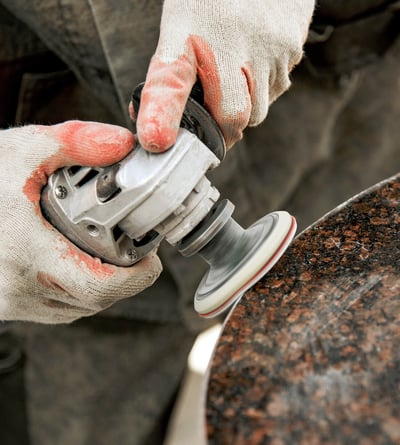
Workers who operate powered hand tools: grinders, saws, and high-speed polishers, face some of the highest silica exposures in countertop and stone industries. Protecting them is a moral and legal obligation.
When Is Silica Dust Exposure at Its Highest?
Exposure risk peaks during any dry cutting, grinding, edging, or contouring activity, especially in enclosed workshop environments or indoor job sites with limited ventilation. High-speed power tools accelerate particle generation, creating dense clouds of respirable silica in seconds.
In manufactured stone product facilities, risk also spikes when:
- Opening bags of ground quartz or bulk raw materials
- Cleaning and scraping mixers or processing equipment
- Emptying or servicing dust collector baghouses without proper controls
OSHA & Niosh Silica Exposure Limits Explained
Employers are legally required to monitor and control silica exposure levels in the workplace. Two key thresholds guide compliance:
OSHA PEL: 100 μg/m³ as an 8-hour time-weighted average for respirable crystalline quartz. Exposure above this level requires immediate corrective action.
NIOSH REL: 50 μg/m³ across up to a 10-hour workday, 40-hour workweek. NIOSH recommends this stricter standard for maximum worker protection.
If air sampling reveals levels above the OSHA PEL, employers must implement controls to bring exposure below the limit. CleanLeaf filtration systems serve as a critical layer of secondary protection when primary controls alone are insufficient.
Reference: OSHA Worker Exposure to Silica during Countertop Manufacturing, Finishing and Installation
How Cleanleaf Air Filtration Controls Silica Dust
CleanLeaf industrial air filtration systems are engineered specifically for environments where fine particulate matter, like crystalline silica, poses a serious health hazard. Here's what sets CleanLeaf apart:
- Removes up to 99.97% of airborne particulates by drawing contaminated air through multiple stages of high-efficiency filters
- Exchanges room air 8-10 times per hour, continuously cycling and cleaning the breathing zone
- Available in a range of modular and portable unit sizes to fit workshops, fabrication facilities, job sites, and finishing areas
- Configurable filter combinations to match the specific demands of your application, from fine silica dust to chemical vapors and odors
CleanLeaf doesn't just filter air, it transforms the entire working environment. Workers breathe easier, feel cooler, and operate more safely with every unit installed.
Real-World Results: Cleanleaf in Action
Granite Transformations, a stone countertop fabrication company, had tried multiple approaches to improve indoor air quality in their manufacturing facility but struggled to reduce airborne particles and epoxy odors effectively.
After deploying a CleanLeaf air filtration system above their main production area, the results were immediate and measurable:
- Air quality improved noticeably throughout the facility
- Epoxy odors were significantly reduced
- Workers reported that improved air circulation also helped keep them comfortable on hot workdays
"The air quality has become noticeably better and the epoxy odors have also been greatly reduced!" — Granite Transformations
Building a Complete Silica Exposure Control Plan
No single solution eliminates silica risk entirely. OSHA and safety best practices call for a layered approach:
- Engineering Controls: Wet cutting methods, local exhaust ventilation, and enclosed processes that capture dust at the source
- Work Practice Controls: Limiting dry sweeping, scheduling high-dust tasks during low-occupancy periods, and using vacuum-equipped tools
- Administrative Controls: Rotating workers to limit individual exposure, mandatory training on silica hazards, and regular air monitoring
- Personal Protective Equipment (PPE): Properly fitted respirators rated for silica dust exposure
- Supplemental Air Filtration: CleanLeaf systems provide continuous ambient air cleaning, capturing residual silica particles that bypass primary controls
Together, these measures form a defense-in-depth strategy that protects workers, satisfies OSHA inspectors, and supports a culture of workplace safety.
FAQs: Silica Dust Control
What is crystalline silica and why is it dangerous?
Crystalline silica is a naturally occurring mineral compound found in rocks, sand, and building materials like granite, quartzite, and concrete. In their finished, solid form these materials are harmless.
The danger begins when they are cut, ground, drilled, or polished, releasing microscopic respirable particles into the air. Once inhaled, those particles are permanently trapped in lung tissue, causing progressive scarring (silicosis), reduced oxygen capacity, and elevated risk of lung cancer, COPD, and kidney disease. There is no cure for silicosis, making prevention the only option.
What is the OSHA permissible exposure limit (PEL) for silica dust?
OSHA sets the general industry PEL for respirable crystalline quartz at 100 μg/m³ as an 8-hour time-weighted average. If air sampling shows levels above this threshold, employers are legally required to take corrective action.
NIOSH recommends a more protective limit of 50 μg/m³ across a full 10-hour shift. CleanLeaf filtration systems can serve as a key tool in achieving and maintaining compliance with both standards.
How does CleanLeaf help control silica dust in the workplace?
CleanLeaf industrial air filtration units draw contaminated air through multiple stages of high-efficiency filters, capturing up to 95% of airborne particulates, including fine crystalline silica.
The systems are designed to exchange room air up to 8 times per hour, continuously cleaning the ambient air in fabrication shops, finishing areas, and production facilities. Units are available in modular and portable configurations with customizable filter combinations to match specific applications.
Is air filtration alone enough to protect workers from silica?
No single measure fully eliminates silica risk.
The most effective programs use a layered control strategy: engineering controls like wet cutting and local exhaust ventilation capture silica at the source; work practice controls limit unnecessary exposure; PPE such as properly fitted respirators provides personal protection; and CleanLeaf ambient air filtration handles residual airborne particles that bypass primary controls.
This defense-in-depth approach delivers the strongest protection and the most defensible OSHA compliance posture.
Which industries are most affected by silica dust exposure?
Any industry that involves cutting, grinding, drilling, or processing materials containing crystalline silica faces elevated risk.
The highest-exposure sectors include stone countertop fabrication and installation, masonry and tile work, foundries, glass manufacturing, ceramics and pottery production, construction and demolition, and landscaping with natural stone. Workers operating high-speed power tools: grinders, dry saws, and polishers, face especially concentrated silica exposure.
Can CleanLeaf units also help with other airborne hazards?
Yes. While CleanLeaf systems are highly effective for capturing silica dust, their multi-stage filtration also addresses other common workplace air quality concerns, including epoxy vapors, adhesive odors, and general particulate matter.
At Granite Transformations, deploying a CleanLeaf unit not only improved silica control but also significantly reduced epoxy odors, an added benefit the team noticed immediately.
How do I know if my workplace needs a CleanLeaf air filtration system?
If your operations involve any form of cutting, grinding, drilling, or dry finishing of stone, concrete, ceramic, or masonry materials, silica exposure is a likely concern.
Start by reviewing OSHA's guidelines and consider commissioning air sampling to measure actual exposure levels. If results approach or exceed 50–100 μg/m³, supplemental filtration should be part of your response plan.
You may also like:
- Why Choose CleanLeaf?
- Granite Transformations Case Study: Granite & Silica Dust Removal
- Airflow vs. Static Pressure