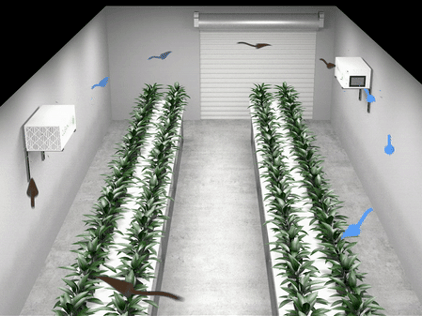
How CleanLeaf Air Filtration Systems Work Summary
CleanLeaf air filtration systems remove airborne contaminants by pulling polluted air through high-efficiency, multi-stage filtration and returning clean air back into the space, without ductwork or HVAC disruption.
Using centrifugal blowers, micro-glass filters, optional carbon filtration, and HEPA upgrades, CleanLeaf systems capture fine particulates, smoke, odors, and VOCs across commercial and industrial environments.
Available in pass-through and T-style airflow configurations, these systems are designed for scalable performance, strategic placement, and measurable air quality improvement.
Table of Contents
How CleanLeaf Air Filtration Systems Work
CleanLeaf air filtration systems operate by continuously circulating indoor air through a high-powered centrifugal blower and a series of advanced filters .
Contaminated air is drawn into the unit, passed through multi-stage filtration that captures sub-micron particles, and discharged back into the room as clean, reusable air. This recirculating design eliminates the need for ductwork while preserving heating and air conditioning efficiency.
CleanLeaf systems use high-efficiency micro-glass filter media designed to capture fine particulates such as smoke, dust, and airborne debris.
For applications requiring odor or gas-phase control, select models include:
For environments with strict cleanliness requirements, HEPA filtration options are available, capable of capturing up to 99.99% of airborne particulate down to sub-micron sizes.
This modular filtration approach allows systems to be configured based on contaminant type, load, and air quality goals.
Air Filtration Configurations: Pass-Through vs. T-Style
CleanLeaf air filtration systems are available in two airflow configurations to match different space layouts and performance requirements.
Pass-Through Configuration
Pass-through air cleaners move air in a straight-line path through the unit.
Key characteristics:
Intake on one end, exhaust on the opposite end
Linear airflow through the filter stack
Consistent, directional air movement
Ideal for long, narrow, or segmented spaces
T-Style Configuration
T-style air cleaners maximize filtration capacity by pulling air from both sides.
Key characteristics:
Dual inlets on opposing ends
Dual filter banks for increased media surface area
Clean air discharged from a central outlet
Best suited for high particulate loads or spaces requiring maximum filtration
Both configurations are engineered for rapid, reliable air cleaning across a wide range of applications.
System Planning & Air Exchanges
CleanLeaf air cleaners perform best when designed as part of a coordinated system.
Each model has a defined “catch” and “throw” distance , which determines how far contaminated air is drawn into the unit and how far clean air is projected back into the space. Proper spacing allows air to flow continuously from one unit to the next.
By positioning units around the perimeter or near room corners, systems can create a circular airflow pattern that filters the same air multiple times.
This process is measured in air exchanges per hour (ACH) . Required ACH levels depend on:
Room size and layout
Type and concentration of airborne contaminants
Occupancy or production processes
Target air cleanliness standards
Applications & Installation Options
CleanLeaf air filtration systems are designed for real-world environments where reliable, scalable filtration is required .
Installation benefits include:
No ductwork required
Plug-and-play electrical setup
Ceiling-mounted or suspended installation options
Preserves valuable floor space
No loss of heating or cooling efficiency
Portable air cleaning units are also available for smaller spaces or temporary filtration needs, allowing systems to scale with changing requirements.
Design Support & Engineer Expertise With more than 40 years of experience in the air filtration industry, CleanLeaf provides full support beyond equipment delivery.
Our clean-air specialists can assist with:
System sizing and airflow modeling
Placement and spacing recommendations
CAD drawings and layout planning
Specifications and bills of materials
Application-specific engineering consultation
From single-room installations to complex multi-unit systems, CleanLeaf delivers solutions built for long-term performance.
FAQs: Air Filtration Systems
What contaminants do CleanLeaf air cleaners remove?
CleanLeaf air cleaners remove airborne particulate such as smoke, dust, fine debris, and other pollutants. Optional carbon filtration helps reduce odors and VOCs, while HEPA configurations provide medical-grade particulate removal.
Do CleanLeaf air cleaners require ductwork?
No. CleanLeaf systems are self-contained and recirculate clean air directly back into the room, eliminating the need for ducting or HVAC modifications.
What is the difference between pass-through and T-style airflow?
Pass-through systems move air in a straight line from one end to the other. T-style systems pull air from both sides and discharge clean air through the center, increasing filtration capacity for higher contaminant loads.
How many air cleaners do I need for my space?
The number of units depends on room size, ceiling height, contaminant levels, and required air exchanges per hour (ACH). CleanLeaf specialists can provide sizing and placement recommendations.
Can CleanLeaf systems help with odors and VOCs?
Yes. Models equipped with activated carbon filters or carbon banks are designed specifically for odor control and VOC reduction.
Are CleanLeaf air cleaners portable?
CleanLeaf offers both fixed and portable air cleaning solutions, allowing systems to scale for permanent installations or smaller, flexible spaces.