PCO vs. HEPA Air Filtration: Which Technology Is Right for You?
Summary
Not all air filtration technologies are created equal. PCO (photocatalytic oxidation) and HEPA (high-efficiency particulate air) filters take fundamentally different approaches to cleaning indoor air, and the differences matter. This article breaks down how each technology works, where each falls short, and why HEPA filtration is the superior choice for facilities that demand clean, safe, and contaminant-free air.
Table of Contents
The 4 Major Airborne Threats in Commercial Facilities
Commercial and controlled-environment facilities face four primary airborne threats: mold, pollen, pests, and bacteria. Standard ventilation systems move air, but they are not designed to capture or neutralize these contaminants. Air filtration systems are essential for any facility where air quality directly impacts product quality, worker safety, or regulatory compliance.
Choosing the wrong filtration technology doesn't just underperform, it can actively introduce new hazards into your environment.
What Is PCO Technology and What Are Its Limitations?
Photocatalytic oxidation (PCO) uses UV light combined with a catalyst to chemically break down gaseous pollutants and volatile organic compounds (VOCs). In theory, this process converts harmful compounds into harmless carbon dioxide and water. In practice, however, the results are far more complicated.
The core problems with PCO in airflow applications:
- Incomplete oxidation produces dangerous byproducts. For VOCs to be fully neutralized, the UV light intensity, catalyst quality, and airflow speed must be perfectly balanced. In real-world conditions, this balance is rarely achieved. Testing has shown that incomplete VOC breakdown can produce up to four times more formaldehyde in the air than was present before filtration, a substance classified as a known human carcinogen.
- PCO does not remove particulate matter. The EPA has stated clearly that PCO air cleaners "are not designed to remove particulates," and that "currently available catalysts are ineffective in destroying gaseous pollutants in indoor air." Mold spores, pollen, dust, and other particles may be chemically altered, but they remain suspended in the air.
- Independent research confirms the risk. A 2015 Concordia University study found that PCO technology — already widely available commercially — was inadvertently introducing chemicals more dangerous than those it was meant to remove.
PCO has demonstrated some effectiveness in stationary applications, such as preventing mold growth within HVAC ductwork. But in active airflow environments where clean air is a operational necessity, the risks outweigh the benefits.
Why HEPA Filtration Sets the Standard
HEPA filtration works through a fundamentally different mechanism: rather than attempting to chemically alter contaminants, it physically captures them within a dense filter media, preventing them from ever re-entering the space.
Key facts about HEPA technology:
- Originally developed in the 1940s for the Manhattan Project to capture radioactive particles, HEPA has been refined over decades for use in hospitals, pharmaceutical manufacturing, semiconductor fabrication, and other environments where air purity is non-negotiable.
- True HEPA filters remove 99.99% of airborne particulate down to 0.3 microns in size. For context, the human eye cannot detect particles smaller than approximately 40–50 microns — meaning HEPA captures contaminants entirely invisible to the naked eye.
- HEPA filtration creates a surgical-grade clean room environment, eliminating the particulate matter that PCO technology simply cannot address.
- There are no harmful byproducts. HEPA filters trap contaminants rather than chemically reacting with them, making them inherently safe for both people and sensitive equipment.
For any commercial facility where airborne particulate poses a risk to product quality, compliance, or occupant health, HEPA is the established industry benchmark.
Head-to-Head: CleanLeaf HEPA vs. PCO Performance Data
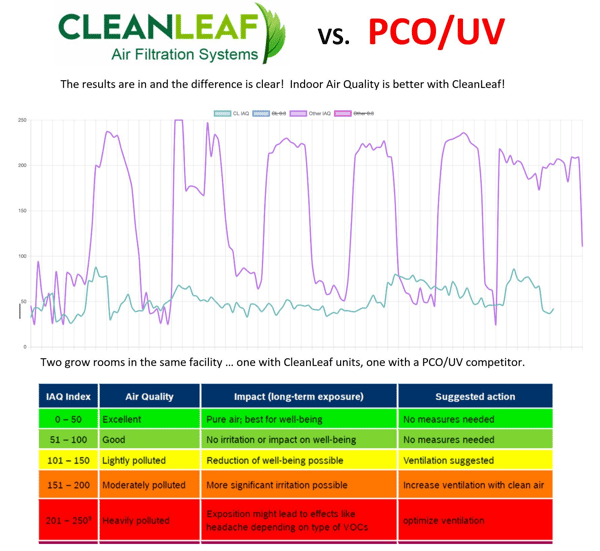
CleanLeaf conducted a side-by-side comparison of our HEPA-based air filtration units against a leading PCO/UV competitor operating within the same facility. Both units ran simultaneously in comparable spaces under identical conditions.
Results:
- CleanLeaf HEPA units consistently maintained an IAQ (Indoor Air Quality) index below 100 — the threshold associated with excellent air quality requiring no additional corrective action.
- The PCO/UV competitor produced readings that ranged predominantly above 100 and into the 250 range, indicating heavily polluted indoor air throughout the test period.
The data confirms what the science already suggests: HEPA filtration delivers measurably cleaner air with no harmful tradeoffs.
FAQs: PCO and HEPA Air Filtration
What is the main difference between PCO and HEPA filtration?
HEPA filters physically trap airborne particles within a filter medium, removing them from circulation entirely. PCO technology uses UV light and a catalyst to chemically break down gaseous pollutants, but does not remove particulate matter and can produce harmful byproducts when the oxidation process is incomplete.
Is PCO filtration dangerous?
PCO technology carries documented risks in active airflow applications. Research has shown that incomplete oxidation of VOCs can generate formaldehyde and other potentially harmful byproducts at elevated concentrations. The EPA has also noted that PCO cleaners are ineffective at removing particulates from indoor air.
What does HEPA stand for, and what does it filter?
HEPA stands for High-Efficiency Particulate Air. True HEPA filters capture 99.99% of airborne particles 0.3 microns and larger, including mold spores, pollen, bacteria, dust, and other fine contaminants.
Can PCO and HEPA be used together?
Some systems combine both technologies. However, given the documented risks associated with PCO in airflow environments, it is important to verify that any combined system has been independently tested for byproduct emissions before use in sensitive commercial settings.
Why is HEPA considered the gold standard for commercial air filtration?
HEPA filtration has decades of proven performance across the most demanding industries — healthcare, aerospace, pharmaceuticals, and defense. It removes contaminants physically rather than chemically, produces no harmful byproducts, and consistently delivers measurable, verifiable results.
How do I know which filtration system is right for my facility?
The right choice depends on the nature of your airborne threats. If particulate matter — mold, pollen, dust, bacteria — is your primary concern, HEPA is the clear choice. If you are also managing VOCs, a HEPA-first system with independently validated supplementary technology may be appropriate. Contact CleanLeaf for a facility-specific consultation.
You may also like:
- How Does CleanLeaf Work?
- Horticulture HEPA Air Filtration
- HEPA Air Filtration for Commercial Applications