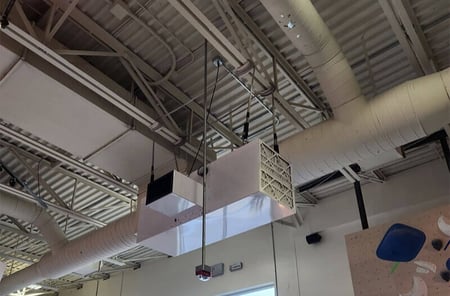
5 Key Questions to Ask Before Choosing an Air Filtration System
Summary
Choosing the wrong air filtration system for your facility doesn't just underperform, it can leave employees and customers exposed to hazardous contaminants, drive up energy and maintenance costs, and create regulatory liability. The right system depends on answering five critical questions about your application, your space, and your air quality requirements. This guide walks through each question in detail so you can make a confident, informed decision.
Why Air Filtration Matters in Commercial and Industrial Facilities
Effective air filtration does more than improve comfort, it actively protects the health and safety of everyone in the space. When properly sized and positioned, air filtration systems prevent hazardous contaminants from entering breathing zones, reduce particulate settlement on work surfaces and equipment, lower the risk of employee injury, and minimize costly production disruptions.
Commercial and industrial facilities rely on air filtration to capture a wide range of airborne threats — welding fumes, woodworking dust, tobacco smoke, VOCs, mold spores, bacteria, and more. CleanLeaf air filtration systems are engineered across multiple configurations to address the full spectrum of these challenges, delivering cleaner air, reduced energy consumption, and lower maintenance costs across virtually any commercial application.
1. What Type of Air Filtration System Is Right for My Application?
The right filtration solution starts with understanding what you are trying to capture. The type of airborne contaminants present in your facility, and the concentration at which they occur, determines which filter configuration will deliver the performance you need.
CleanLeaf air filtration systems are available in the following primary configurations:
General Use — For dust and smoke applications where odor control is not a requirement. Ideal for warehouses, general manufacturing, and similar environments where particulate is the primary concern.
Carbon Filter — CF (Light Odor Control) — For facilities managing moderate, everyday odors. The CF configuration uses activated charcoal afterfiltration to capture and neutralize VOCs and nuisance odors. Refer to the Carbon Absorption Qualities Chart to evaluate charcoal effectiveness for your specific application.
Carbon Module — CC (Heavy Odor Control) — For applications with persistent, heavy, or regulated odor loads. The CC configuration uses an 18 lb or 36 lb carbon module for deep, sustained adsorption in demanding environments. See the Carbon Absorption Qualities Chart for performance data relevant to your scenario.
HEPA — HE (Surgical-Grade Clean Air) — For applications requiring the highest level of particulate removal. CleanLeaf HEPA systems capture 99.99% of airborne particles down to 0.3 microns, making them the standard choice for cultivation facilities, laboratories, healthcare environments, and sterile manufacturing.
Wrap-Around Filter — WA/WAL/WAR (Heavy Particulate Environments) — Designed to extend pre-filter service life in applications where large volumes of coarse particulate cause standard pre-filters to face-load quickly. Woodworking shops, grain handling facilities, and high-dust manufacturing environments are typical applications.
Not sure which configuration fits your facility? CleanLeaf specialists are available to assess your application and recommend the right system.
2. How Do I Calculate the CFM My Facility Requires?
CFM (cubic feet per minute) is the measure of how much air passes through a filtration system at any given moment. Getting this number right is the foundation of proper system sizing. Install too little CFM capacity and contaminants will accumulate faster than the system can capture them. Install too much without strategic placement and you may still end up with dead zones.
Step 1: Calculate the volume of your space
Multiply the length, width, and ceiling height of your facility:
L × W × H = Total Room Volume (cubic feet)
Step 2: Apply the air exchange rate
CleanLeaf systems are designed to exchange facility air 8 times per hour.
CFM = (Room Volume × Air Changes per Hour) ÷ 60
Example Calculation:
- Room dimensions: 40 ft × 30 ft × 30 ft = 36,000 cubic feet
- 36,000 × 8 air changes per hour = 288,000
- 288,000 ÷ 60 minutes = 4,800 CFM required
CleanLeaf systems span a CFM range designed to serve commercial and industrial facilities of all sizes. Our team can help you match the right unit configuration to your calculated CFM requirement.
3. How Many Air Changes Per Hour Does My Application Need?
An air change occurs each time the total volume of air in your facility passes through the filtration system's circular airflow pattern. The number of air changes required per hour is not one-size-fits-all, it varies based on the nature and concentration of contaminants, the sensitivity of the environment, and any applicable regulatory standards.
Higher-risk applications — those with heavy particulate loads, biological contamination concerns, strong odors, or strict compliance requirements — typically require more frequent air exchanges to maintain safe, clean conditions. Lower-risk general use environments may require fewer exchanges per hour to achieve the same result.
CleanLeaf specialists can evaluate your specific application and recommend the appropriate air change rate for your facility. Getting this number right from the start ensures your system delivers the air quality your environment demands.
4. How Should Air Filtration Systems Be Placed for Maximum Effectiveness?
Proper placement is just as important as selecting the right system. A correctly specified unit that is poorly positioned will underperform — and no amount of additional units will fully compensate for a fundamentally flawed layout.
CleanLeaf air filtration systems work best when deployed in tandem, positioned to create a circular airflow pattern that continuously draws contaminated air through the filtration stages and returns clean air to the space. This approach ensures that every part of the facility is actively served by filtered air, eliminating the stagnant pockets where contaminants accumulate and where uneven air quality creates localized health and compliance risks.
Strategic placement also:
- Controls VOCs and odors before they migrate to adjacent areas
- Restricts airborne bacteria and biological contaminants from settling on surfaces
- Prevents pest infiltration by maintaining active, clean airflow throughout the space
- Reduces particulate settlement on equipment, reducing maintenance frequency and downtime
Each CleanLeaf unit has a defined catch and throw distance, the range over which it draws in and projects air. These parameters determine how far apart units can be spaced while maintaining a continuous, unbroken airflow pattern. Our team provides placement guidance as part of every system recommendation.
5. How Many Units Do I Need?
The number of CleanLeaf units required for your facility is determined by your total CFM requirement and the CFM output of the units in your chosen configuration. Once you know your required CFM from the calculation in Question 2, matching that number to available unit configurations tells you how many units are needed.
For most commercial and industrial facilities, multiple units deployed strategically will outperform a single large unit — both in terms of airflow consistency and the elimination of dead zones. The goal is not just total CFM capacity, but even distribution of that capacity throughout the space.
CleanLeaf systems are available across a wide CFM range to serve facilities of all sizes — from compact workrooms to large-scale industrial floors. For a specific unit count and placement recommendation based on your facility's dimensions and application, contact our team directly.
FAQs: Air Filtration Systems
How do I know which CleanLeaf configuration is right for my facility?
Start by identifying the primary contaminants in your space. If dust and smoke are your main concerns and odor is not a factor, a general use system will serve you well. If odor is a significant issue, the CF or CC configuration depends on the intensity of the load. If your application requires surgical-grade particulate removal — as in cultivation, healthcare, or laboratory settings — a HEPA configuration is the appropriate choice. CleanLeaf specialists can assess your specific environment and recommend the right configuration.
What is CFM and why does it matter?
CFM stands for cubic feet per minute — the volume of air a filtration system moves in a given time period. Matching your system's total CFM output to your facility's volume and required air exchange rate ensures that contaminated air is being filtered at a sufficient rate to maintain clean, safe conditions throughout the space. Undersized CFM capacity is one of the most common causes of persistent air quality problems in commercial facilities.
How many air changes per hour do I need?
The right number depends on your application. Facilities with heavy particulate loads, biological contamination risks, strong odors, or regulatory air quality requirements typically need more exchanges per hour than general commercial environments. CleanLeaf systems are designed to deliver up to 8 air exchanges per hour, and our specialists can determine the appropriate target rate for your specific application.
Can I use a single large unit instead of multiple smaller ones?
In some situations a single high-capacity unit can satisfy the CFM requirement, but placement and airflow distribution are equally important. Multiple units deployed strategically across a space consistently produce more uniform air quality and eliminate dead zones more effectively than a single unit — even one with sufficient total CFM. A facility layout review from our team can determine the most effective configuration for your space.
What is a circular airflow pattern and why does it matter?
A circular airflow pattern is created when air filtration units are positioned so that filtered air flows continuously from one unit to the next, cycling through the entire space in a loop. This approach ensures that no area of the facility is left with stagnant, unfiltered air — which is where contaminant buildup, mold growth, and localized health risks are most likely to develop. It is the foundation of effective multi-unit air filtration deployment.
What is a wrap-around filter and when do I need one?
Wrap-around filters are pre-filter extensions designed for environments where large volumes of coarse particulate cause standard pre-filters to face-load, meaning the surface becomes clogged, faster than normal. By adding surface area to the pre-filter stage, wrap-around filters extend service intervals and protect the downstream filter stages from premature loading. They are commonly used in woodworking, grain handling, and high-dust manufacturing environments.
How do I get a system recommendation for my specific facility?
Contact CleanLeaf directly with your facility dimensions: length, width, and ceiling height, along with a description of your primary contaminants and application type. Our specialists will calculate your CFM requirement, recommend the appropriate configuration and unit count, and provide placement guidance to ensure your system delivers the air quality your facility requires.
You may also like: