Understanding Indoor Air Quality (IAQ): A Guide to Healthier Commercial Spaces
Summary
Indoor air quality affects the health, comfort, and productivity of everyone inside a building, and in commercial and industrial environments, the stakes are even higher. From welding fumes and woodworking dust to secondhand smoke and kitchen grease, the range of airborne threats in commercial settings is broad and consequential. This guide explains what indoor air quality actually means, where contamination comes from, how air filtration systems address it, and what to look for when choosing the right solution for your facility.
Table of Contents
What Is Indoor Air Quality (IAQ) and Why Does It Matter?
Indoor air quality refers to the condition of the air within and immediately around buildings and structures, particularly as it relates to the health, comfort, and safety of the people inside. Poor IAQ is not just an inconvenience; it is a documented driver of respiratory illness, reduced cognitive performance, employee absenteeism, and long-term chronic health conditions.
The primary categories of indoor air pollutants include:
- Particulate matter (PM) — Airborne solids and liquids including dust, pollen, pet dander, smoke, and fine industrial particles
- Volatile organic compounds (VOCs) — Gases released from everyday products, materials, and industrial processes that contribute to odors and chemical exposure
- Biological contaminants — Mold spores, bacteria, viruses, and allergens that thrive in enclosed, poorly ventilated spaces
It is also important to recognize that outdoor pollutants, vehicle exhaust, industrial emissions, and seasonal particulate, can infiltrate commercial and industrial facilities through ventilation systems and entry points, compounding the indoor contamination load. Managing these threats proactively is essential for protecting the health and well-being of both staff and patrons.
Common Indoor Air Pollutants and Where They Come From
Indoor air contamination in commercial environments rarely comes from a single source. Understanding the specific pollutants present in your facility is the first step toward selecting an effective filtration solution.
Particulate Matter includes dust, pollen, smoke particles, and fine debris generated by industrial or processing activity. These particles range in size and can penetrate deep into the respiratory system, particularly at the fine and ultrafine end of the spectrum.
Volatile Organic Compounds (VOCs) are released during manufacturing, finishing, cleaning, and cooking processes. They contribute to unpleasant odors and, at sufficient concentrations, can cause irritation, headaches, and more serious health effects with prolonged exposure.
Mold and Biological Contaminants are especially prevalent in environments with elevated humidity or inadequate air circulation. Mold spores and bacteria circulate through the air and can affect both occupant health and, in cultivation or food production settings, product quality and regulatory compliance.
Secondhand Smoke and Combustion Byproducts contain thousands of chemical compounds, many of them carcinogenic, and represent one of the most well-documented indoor air quality hazards in hospitality and entertainment environments.
IAQ Challenges Across Commercial and Industrial Applications
Different industries generate different airborne threats, and each requires a targeted approach to effective air quality management.
Welding and Metalworking
Welding fumes release toxic metals including manganese and hexavalent chromium. When inhaled, these compounds can cause severe respiratory conditions including metal fume fever and long-term lung disease.
Fine particulate generated during machining processes presents both immediate and cumulative health risks to workers.
Woodworking Facilities
Both small shops and large-scale woodworking operations generate substantial volumes of airborne dust rich in allergens and potentially carcinogenic compounds. Prolonged exposure to woodworking dust is associated with chronic respiratory conditions including asthma, chronic bronchitis, and in severe cases, lung cancer.
Cigar Lounges, Bars, and Smoking Environments
Secondhand smoke is one of the most extensively studied indoor air pollutants. It contains thousands of chemicals, many of which are carcinogenic, and regular exposure increases the risk of respiratory and cardiovascular disease among employees and patrons.
Beyond health concerns, a smoky, hazy environment directly impacts the customer experience and makes it difficult to build a loyal customer base.
Commercial Kitchens
Cooking generates grease particles, steam, and VOCs that accumulate rapidly in enclosed kitchen spaces.
These contaminants cause foul odors and respiratory irritation for kitchen staff and, in facilities where kitchens are adjacent to office or retail areas, can spread discomfort throughout an entire building.
Climbing Gyms and Fitness Facilities
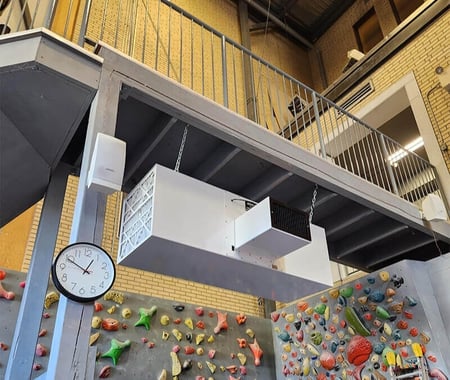
High-occupancy environments with elevated physical activity generate significant amounts of airborne chalk dust, particulate from flooring and equipment, and biological contaminants from human activity, all of which contribute to poor IAQ and occupant discomfort.
How Air Filtration Systems Improve Indoor Air Quality
Air filtration systems improve IAQ by drawing contaminated air through specialized filter media that captures pollutants before returning clean air to the space. The core components: fans and filters, are available in a wide range of types and configurations designed to meet specific CFM requirements and target particular contaminant types.
Selecting the right system requires evaluating several key variables:
- The specific types of airborne contaminants present in your facility
- The size and ceiling height of the space requiring coverage
- The target level of air quality for your application and any applicable regulatory requirements
- Operational budget, including both upfront equipment cost and ongoing filter replacement expenses
CleanLeaf air filtration systems are engineered across multiple configurations to address the full spectrum of commercial and industrial IAQ challenges, from general dust and particulate capture to HEPA filtration and heavy-duty odor control.
CleanLeaf Filtration Configurations: Matching the Right System to Your Application
General Use — Dust and Particulate Control
CleanLeaf general use systems feature a 1" pleated pre-filter followed by a pocket bag filter at either 65% or 95% efficiency. These units are highly effective at capturing and filtering dust and airborne particulate in applications where odor control is not a primary concern. By continuously cycling and cleaning the air, they maintain a measurably healthier working or living environment.
HEPA Filtration — Clean Room Applications
For applications requiring the highest level of particulate removal, CleanLeaf HEPA systems incorporate a 1" or 4" pleated pre-filter, a 95% pocket bag filter, and a 99.99% HEPA afterfilter capable of capturing particles as small as 0.3 microns. These systems are the standard of choice for hospitals, sterile manufacturing environments, laboratories, cultivation facilities, and any application where surgical-grade air cleanliness is required.
Light Odor Control (CF Configuration)
CleanLeaf CF systems are designed for applications with moderate odor loads. They feature a 1" or 4" pleated pre-filter, a pocket bag filter at 65% or 95% efficiency, and a 2" charcoal afterfilter containing 9 lbs of activated carbon. Ideal for spaces where plant, terpene, or everyday operational odors need to be consistently managed.
Heavy Odor Control (CC Configuration)
For facilities with demanding or regulated odor requirements, CleanLeaf CC systems deliver deep odor adsorption through an 18 lb or 36 lb carbon module paired with a 1" or 4" pleated pre-filter and a 95% pocket bag filter. These systems are purpose-built for environments like flowering rooms, cigar lounges, and processing facilities where odor migration is a serious operational and compliance concern.
Air Exchanges: The Key to Consistent Air Quality
Effective air filtration is not just about having the right system, it is about deploying it correctly. CleanLeaf systems are positioned strategically to create a circular airflow pattern, ensuring that filtered air reaches every part of the space rather than leaving stagnant zones where contaminants accumulate.
Each CleanLeaf unit has a specific catch and throw distance that determines how far apart units can be placed while maintaining continuous airflow from one to the next. The frequency at which air completes this circulation pattern is called an air exchange, and the number of air exchanges per hour is one of the most direct measures of a filtration system's effectiveness.
The required number of air exchanges per hour varies by application. Higher-risk environments, those with heavy particulate loads, biological contamination concerns, or strict regulatory requirements, typically require more frequent exchanges. Our team can help you determine the right exchange rate and unit placement for your specific facility.
IAQ Regulations and Compliance
Many regions have established regulations and standards governing indoor air quality in commercial and industrial settings. Compliance with these standards protects the health and safety of workers and patrons, reduces liability exposure, and in many industries is a direct licensing or permit requirement.
Beyond regulatory compliance, facilities with well-maintained IAQ systems benefit from reduced energy costs, lower maintenance expenses, improved production rates, and a measurable reduction in employee health-related absenteeism.
For guidance on the IAQ regulations applicable to your industry and location, our specialists are available to help you assess your current setup and identify the right filtration solution for your compliance and operational needs.
FAQs: Indoor Air Quality
What is indoor air quality (IAQ) and how is it measured?
Indoor air quality refers to the condition of the air inside a building as it relates to the health and comfort of its occupants. It is typically measured through a combination of particulate concentration testing, VOC monitoring, humidity readings, and biological contaminant sampling.
An IAQ index below 100 is generally considered excellent, requiring no additional corrective action, while readings above that threshold indicate increasing levels of airborne pollution.
What are the most common sources of poor indoor air quality in commercial facilities?
The most common sources vary by industry but broadly include airborne dust and particulate from manufacturing or processing activity, VOCs from coatings, cleaning products, and cooking, biological contaminants like mold spores and bacteria, and combustion byproducts from smoking, welding, or kitchen operations.
Outdoor pollutants entering through ventilation systems also contribute to indoor contamination loads.
How does HEPA filtration differ from standard air filtration?
Standard filtration systems typically capture larger particles using pleated pre-filters and bag filters. HEPA filtration adds a final stage capable of capturing 99.99% of airborne particles down to 0.3 microns, including fine dust, mold spores, bacteria, and pollen that standard filters cannot reliably remove.
HEPA systems are the appropriate choice for any application requiring surgical-grade air cleanliness.
What is the difference between light odor control and heavy odor control configurations?
CleanLeaf light odor control (CF) systems use a 2" charcoal afterfilter with 9 lbs of activated carbon, well suited for everyday plant, terpene, or operational odors.
Heavy odor control (CC) systems use a significantly larger carbon module, 18 or 36 lbs, designed for environments with persistent, heavy, or regulated odor loads such as flowering rooms, cigar lounges, and processing facilities where odor migration is a serious concern.
What is an air exchange and how many does my facility need per hour?
An air exchange is one complete cycle of the total air volume in a space passing through the filtration system. The number of exchanges required per hour depends on your application, the type and concentration of contaminants, the size of the space, and any applicable regulatory standards.
CleanLeaf systems are designed to deliver 8-10 air exchanges per hour, and our team can help determine the right exchange rate for your specific facility.
Can one CleanLeaf unit cover my entire facility?
That depends on the size of your space and your CFM requirements. CleanLeaf units are available across a range of CFM capacities, and for larger facilities, multiple units are typically deployed in a strategic pattern that creates circular airflow and eliminates stagnant zones.
Our team can calculate the right number of units and optimal placement for your space.
How does poor indoor air quality affect employees and customers?
Poor IAQ is linked to a wide range of health effects: from immediate symptoms like eye irritation, headaches, and respiratory discomfort to long-term conditions including chronic bronchitis, asthma, and in some industrial environments, serious occupational diseases.
In customer-facing businesses, poor air quality also directly impacts the experience, reputation, and ultimately the revenue of the facility.
Are there regulations I need to comply with regarding indoor air quality?
Yes, many jurisdictions have established IAQ regulations and standards for commercial and industrial facilities, with requirements varying by industry, location, and application type. Non-compliance can result in fines, permit issues, and liability exposure.
CleanLeaf specialists can help you understand the specific requirements applicable to your facility and identify the right filtration solution to meet them.
You may also like:
- Troubleshooting Commercial Air Quality Issues
- 4 Reasons to Invest in Commercial Air Filtration
- How CleanLeaf Air Cleaners Work